
If a decision feels urgent, emotionally loaded, or strangely impossible to think through, do not assume your intuition is giving you a clear answer.
You may be experiencing a stress response.
The difference matters. Regulated intuition can help you notice patterns, timing, and subtle information that logic has not yet organized. Stress-driven reactivity can feel just as convincing: but it tends to narrow your options, exaggerate threats, and push you toward immediate relief rather than long-term alignment.
For founders, high-performing leaders, and anyone making money decisions, this distinction can change everything.
Recent research is making the biology clearer. An August 2026 randomized controlled study in Scientific Reports, titled “Stress-induced cortisol clouds the gut feeling in decision-making”, examined how acute stress and cortisol affect the bodily signals people use when making risky choices. The findings suggest that stress-related cortisol can disrupt the connection between anticipatory bodily signals and decision-making: meaning your “gut feeling” may become less reliable when your system is under pressure.
The practical takeaway is simple:
Before asking, “What should I do?” ask, “What state am I deciding from?”
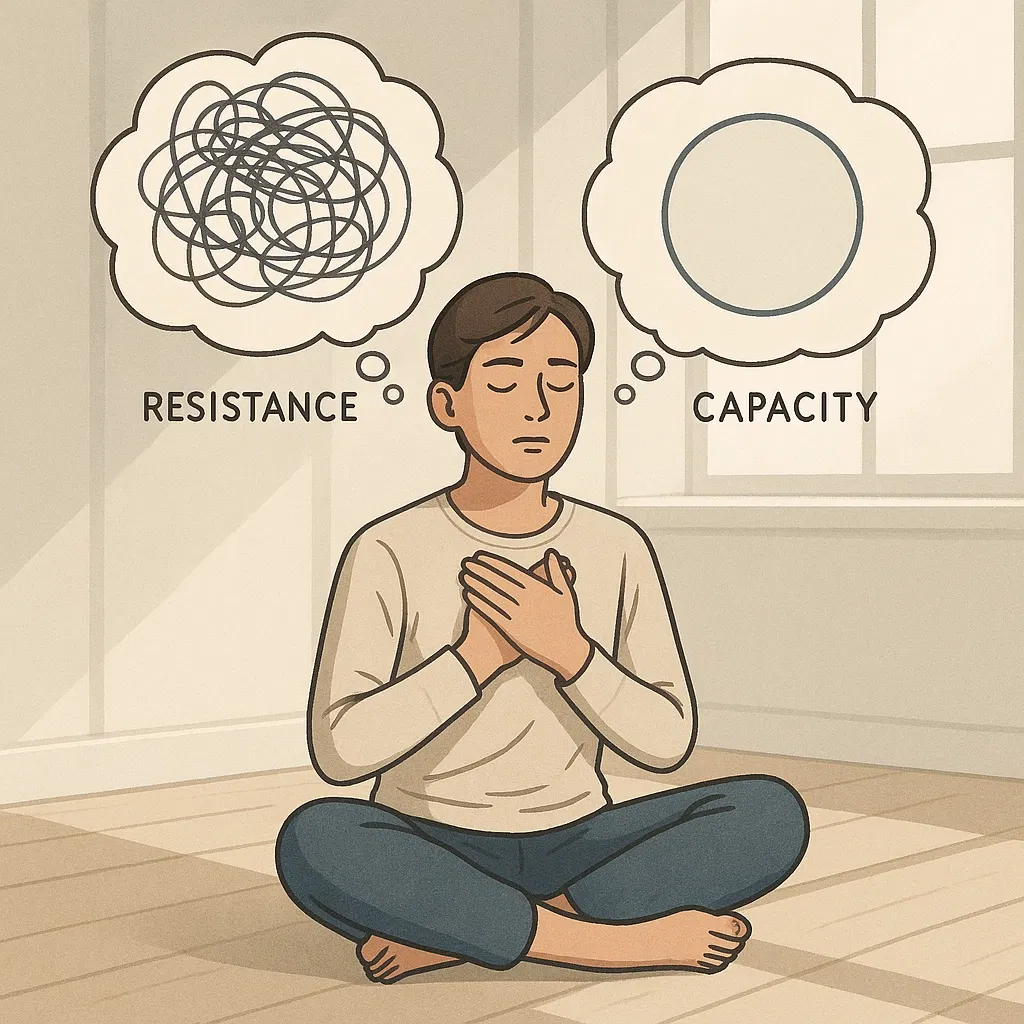
Your gut feeling is not always intuition
People often use “gut feeling” to describe any strong internal reaction. But not every body signal is intuition.
Your body is constantly sending information to the brain: changes in heart rate, breathing, muscle tension, temperature, digestion, and energy. This process is called interoception: the sensing and interpretation of internal bodily states.
Interoception is not one single ability. It includes several dimensions:
- Noticing what is happening inside your body
- Accurately detecting internal signals
- Interpreting those signals
- Regulating your attention
- Trusting your body without automatically obeying every sensation
This is why a tight chest can mean different things in different moments. It might reflect a genuine warning. It might be excitement. It might be an old survival pattern activated by uncertainty.
The sensation is real. The interpretation may not be.
A regulated nervous system gives you more room to investigate the signal before turning it into a decision.
What cortisol can do to financial decisions
Cortisol is not bad. It is a useful hormone involved in energy mobilization, attention, and adaptation. A short-term rise can help you respond to a real challenge.
The problem is not cortisol itself. The problem is making complex decisions while your stress system is treating uncertainty as danger.
The 2026 Scientific Reports study helps explain why. Researchers examined acute psychosocial stress, cortisol reactivity, anticipatory skin conductance responses, and risky decision-making. Skin conductance responses are one way researchers study bodily signals that appear before a person consciously identifies a preference or warning.
The study reported that cortisol reactivity moderated the relationship between these anticipatory bodily signals and risky choices. In other words, the body’s early warning signals did not operate in the same way under stress. The reported effect was particularly evident in male participants, which is an important limitation: not a reason to generalize the findings to every person or every decision.
For leaders, this has a practical implication: stress may not simply make you “more risk-taking” or “more cautious.” It may change how you interpret the information arriving from your body.
That can show up as:
- Taking an unnecessary risk to escape uncertainty
- Rejecting a valuable opportunity because it feels unfamiliar
- Cutting a team member too quickly after one frustrating interaction
- Making an expensive purchase to create a temporary sense of control
- Delaying a necessary investment because the downside feels emotionally overwhelming
- Confusing urgency with importance
This is where money mindset and nervous system regulation meet. Your beliefs about money matter, but your physiological state influences which money belief becomes loudest in the moment.
A second study: interoception shapes perceived stress
An August 2026 paper in the Journal of Physiological Anthropology, “Distinct dimensions of interoception modulate the link between cardiovascular reactivity and perceived stress,” adds another useful layer.
The study focuses on how different dimensions of interoception shape the relationship between cardiovascular reactivity and perceived stress. That distinction is important because the same physical activation can be experienced very differently by different people.
One person notices a faster heartbeat and thinks, “My body is preparing me.”
Another notices the same sensation and thinks, “Something is wrong.”
The body is activated in both cases. The meaning changes the experience.
This research supports a more nuanced view of nervous system regulation. Becoming more aware of your body is not automatically the goal. Awareness without regulation can become hypervigilance. You may notice every sensation but interpret each one as evidence of danger.
The deeper skill is learning to:
- Notice the signal.
- Stay present with it.
- Separate sensation from story.
- Allow the nervous system to settle.
- Decide from a wider range of information.
That is the foundation of regulated intuition.
Regulated intuition versus stress-driven reactivity
Here is a simple comparison.
Regulated intuition often feels:
- Clear, even when the decision is difficult
- Specific rather than globally fearful
- Patient enough to gather relevant information
- Connected to your values and long-term direction
- Open to feedback
- Able to tolerate uncertainty
Stress-driven reactivity often feels:
- Urgent and all-or-nothing
- Focused on immediate relief
- Preoccupied with avoiding embarrassment, loss, or rejection
- Certain that one outcome will determine everything
- Resistant to new information
- Disconnected from your broader goals
Intuition does not always feel comfortable. A regulated decision can still involve fear, grief, or risk. The difference is that the emotion does not completely take over the decision-making process.
You can feel fear and still think.
You can feel excitement and still verify the numbers.
You can sense that a conversation needs to happen without sending the angry message immediately.
A practical reset before a high-stakes decision
Use this short process before signing a contract, making an investment, hiring or firing, changing your pricing, or responding to a difficult email.
1. Name the decision
Write down the actual decision in one sentence.
For example: “Should I invest $25,000 in this growth opportunity?”
This prevents the nervous system from turning one decision into a vague threat about your entire future.
2. Locate the signal
Notice where the response appears in your body. Is it in your chest, throat, stomach, jaw, shoulders, or face?
Do not try to eliminate it. Simply describe it: tight, warm, heavy, fast, numb, restless, or open.
3. Separate sensation from prediction
Ask:
- What do I physically notice?
- What story is my mind adding?
- What evidence supports that story?
- What evidence might challenge it?
This is a simple way to strengthen interoceptive awareness without treating every sensation as a command.
4. Expand the time horizon
Stress narrows attention toward the immediate moment. Ask:
- What would this decision look like in 30 days?
- What would it look like in three years?
- Am I choosing growth, or am I choosing relief?
The “how to make more money nervous system” question is often less about forcing yourself to work harder and more about building the capacity to remain present while evaluating opportunities, risks, and delayed rewards.
5. Delay irreversible action when possible
A regulated nervous system can tolerate a pause.
If a decision is reversible, test it. If it is not reversible, create a review period, ask for outside input, or sleep on it. This is not weakness or indecision. It is a way to prevent a temporary state from creating a permanent consequence.
Why regulation supports high performance
High performance is not the same as constant activation.
High performing leaders need access to multiple states: focused effort, creativity, social connection, recovery, and decisive action. Flow states are easier to access when attention is not consumed by threat monitoring. Clear leadership also requires enough internal steadiness to hear dissent, receive feedback, and change course without experiencing every challenge as a personal threat.
This is why nervous system regulation is not separate from business performance. It influences:
- How you handle volatility
- How you communicate under pressure
- Whether you delegate or over-control
- How you negotiate
- Whether you can recognize opportunity
- How quickly you recover from setbacks
- Whether success feels expansive or exhausting
At Satori Prime, the guiding philosophy is simple: stop trying to make yourself feel better and get better at feeling.
That means developing the capacity to feel activation without being run by it.

Start with the pattern beneath the decision
If the same money or leadership decisions keep repeating, the issue may not be a lack of information. You may be meeting the same protective pattern in different situations.
You can begin by taking the survival patterns guide to identify how stress may be shaping your behavior, attention, and professional performance.
You can also Discover How to release your old patterns in just 9 minutes through Satori Prime’s free introductory training.
And if you want help exploring your specific situation, book a complimentary Vision Call with the Satori Prime team.
FAQ
How can I tell whether a gut feeling is intuition or anxiety?
Intuition is usually specific and steady enough to examine. Anxiety tends to be urgent, repetitive, and focused on catastrophic outcomes. Neither feeling should be ignored, but anxiety benefits from regulation and additional evidence before you act.
Does nervous system regulation guarantee better financial decisions?
No. Regulation does not eliminate uncertainty or guarantee a profitable outcome. It can help you access more information, consider a wider range of options, and avoid making decisions solely to escape a stressful feeling.
Is having strong bodily awareness always helpful?
Not necessarily. Awareness can support self-regulation, but intense attention to bodily sensations can also amplify stress if those sensations are interpreted as dangerous. The goal is regulated awareness, not constant monitoring.
What is the connection between money mindset and the nervous system?
Money beliefs are shaped by personal history, culture, and experience. When your nervous system detects financial threat, old beliefs can become more influential. Regulation creates more space to question those beliefs and choose behavior aligned with your actual goals.
What is the best first step for high-performing leaders?
Start by observing your state before important decisions. Notice whether you are grounded, rushed, shut down, defensive, or seeking immediate relief. Then use a short regulation practice before deciding.
Build the capacity to decide clearly
Your next breakthrough may not come from finding a better strategy.
It may come from no longer asking your body to make a permanent decision while it is bracing for danger.
When your nervous system has more capacity, intuition becomes easier to hear. Money decisions become less reactive. Leadership becomes less performative. And high performance becomes something you can sustain: not something you have to survive.
Ready to build that capacity?
Join Nervous System Mastery: Level 1 Membership for 50% off at $499, with lifetime access. Build a practical foundation for nervous system regulation, clearer decisions, deeper connection, and sustainable performance.
Get lifetime access to Nervous System Mastery: Level 1 for $499
This article is for educational purposes only and is not financial, medical, or mental-health advice. Consider qualified professional guidance for personal investment decisions or clinical concerns.
Sources
- Duplessis-Marcotte, Magnon, and Marin, “Stress-induced cortisol clouds the gut feeling in decision-making: a randomized controlled study,” Scientific Reports
- Tanaka, Shinagawa, Tsuji, and Umeda, “Distinct dimensions of interoception modulate the link between cardiovascular reactivity and perceived stress,” Journal of Physiological Anthropology
- Franco-O’Byrne, Ferdman, and Huepe, “Perceived socioeconomic vulnerability, but not objective poverty, is linked to interoception through perceived stress,” Frontiers in Psychology